
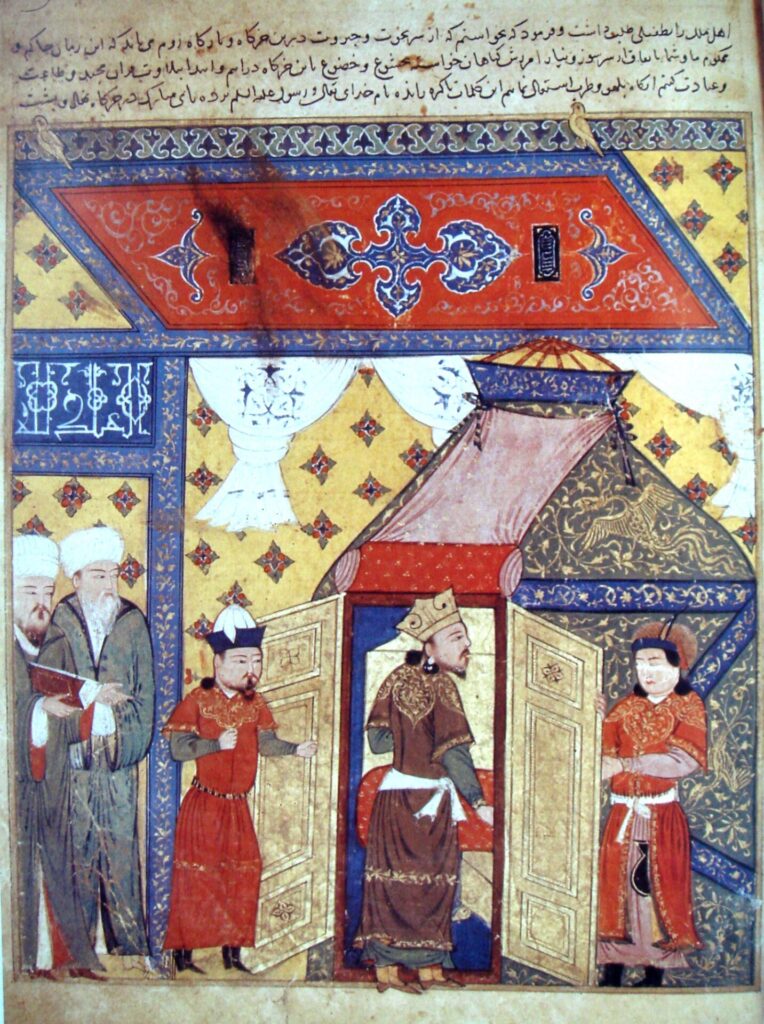
The Mongol Cataclysm
History offers moments so paradoxical they almost seem implausible. One of the most striking was the transformation of the Mongols. In 1258, Hulagu Khan’s forces stormed Baghdad, killing hundreds of thousands and destroying the fabled House of Wisdom, an act that obliterated centuries of Islamic scholarship. Entire libraries were thrown into the Tigris until the river reportedly ran black with ink.
At the time, the Mongols were the terror of the Muslim world, from Samarkand to Baghdad. They burned Qur’ans, razed cities, and were bent on erasing the intellectual foundations of Islamic civilisation. Yet their onslaught was not rooted in religious hatred alone; they were empire-builders seeking dominion. Islam simply happened to stand in their path, and suffered perhaps its most devastating blow.
And yet, within two centuries, the descendants of Genghis Khan became some of Islam’s most devoted rulers and patrons. This remarkable reversal was not achieved through military reprisal or coercion, but through cultural resilience, moral leadership, and the quiet persistence of those who lived Islam with integrity and conviction.
Where the sword failed, the Majestic Qur’an and the elegance of Muslim manners prevailed, softening Mongol hearts and opening them to faith. The grandchildren and great-grandchildren of Genghis Khan embraced Islam, building mosques, nurturing scholarship, and defending the religion they once sought to destroy.
This is one of history’s most astonishing transformations. It shows that while the sword may subdue, only conviction endures. The lesson remains vital for Muslims today, who feel besieged by the political, military, and cultural pressures of the collective West.
From Fear to Faith
For Muslims of the time, the destruction felt apocalyptic. Cities like Nishapur and Merv were almost entirely depopulated; scholars, poets, and theologians executed.
And yet Islam not only survived, it won new adherents and eventually flourished inside Mongol hearts. The process was gradual, unfolding over decades through human contact, spiritual example, and intellectual persuasion. It began with Berke Khan, grandson of Genghis Khan through his son Jochi. As ruler of the Golden Horde (1257 – 1266), he consolidated power and became the first Mongol prince to embrace Islam. Later, leaders such as Ghazan Khan and large segments of the Mongol elite, from Persia to Central Asia, would also adopt the faith.
How did this happen?
a) Muslim Moral and Cultural Resilience
Though armies and cities fell, Muslims preserved what could not be burned – the Qur’an in their hearts, their oral traditions, their intellectual depth, and the ethical conduct of merchants, scholars, and Sufi teachers. In daily trade and governance, Mongol administrators encountered Muslims whose honesty, fairness, and refined etiquette left a lasting impression, even on hardened warriors.
b) Sufi Influence
Sufi masters such as Najm al-Din Kubra, and later the disciples of Jalal al-Din Rumi, offered a vision of life rooted in inner transformation rather than law or politics alone. Their lodges became spaces of encounter, where Mongols could explore Islam without hostility. Conversions often began at this deeply personal, spiritual level.
c) Intermarriage and Cultural Exchange
Mongol elites married into Persian and Turkic Muslim families, accelerating assimilation. Children raised in these households grew up with Islamic values as part of everyday life, bridging cultures and generations.
d) Political Pragmatism of Victors
Rulers such as Ghazan Khan (r. 1295–1304) recognised Islam as a unifying moral framework for their vast, multi-ethnic domains. His own conversion, influenced by his trusted Muslim vizier Rashid al-Din, reflected not only personal conviction but also the practical advantages Islam offered in governance – law, taxation ethics, and social cohesion.
Parallels Today
Today, conscious Muslims feel besieged by the “West”, not by horse-riding armies, but through wars, occupations, cultural domination, economic manipulation, and media narratives that distort Islam. This prolonged assault began with colonial Europe in the 18th and 19th centuries, when deception and “divide and rule” tactics fragmented Muslim lands into weakened states led by compliant elites. Catapults have given way to drone strikes, and libraries to the erasure of history; yet the psychological wounds cut just as deep.
But Muslims themselves have faltered. Corruption corrodes governance, authoritarianism crushes hope, and divisions weaken communities. Poverty, ignorance, and strife persist, leaving a painful reality that cannot be ignored.
Still, the light of Islam endures. The Qur’an’s timeless message remains untainted, and in the very heart of the developed world with lands rich in comfort but haunted by emptiness, Islam is quietly winning new hearts. Strikingly, many are young, educated women seeking inner peace, moral clarity, and protection from a culture that commodifies the human body.
The story of Islam today is not only one of decline but also of rediscovery and transformation. In a fractured, morally broken world, Islam’s ethical, cultural, and spiritual power continues to shine. The Qur’an still whispers its truth: humanity was created for balance, justice, and mercy. Even in the darkest times, God’s light endures.
Lessons for Today’s Muslims
History reminds us that raw resistance alone rarely changes the hearts of power; at times it even invites devastation, especially when victors are ruthless and victims too weak. The Mongols did not embrace Islam because Muslims out-fought or out-manoeuvred them. They embraced it because they encountered a civilisation and a people whose quiet strength and integrity ultimately outshone them.
- Live Islam with Integrity – The most powerful form of outreach is not words but conduct. Kindness to neighbours, fairness in dealing with people of all backgrounds, honesty in trade and transaction – these softened even the hardest of Mongol hearts. In today’s interconnected world, Muslims everywhere are de facto ambassadors of their faith. In Western societies especially, where many are citizens, corruption, hypocrisy, and division within the community cause more damage than any external foe.
- Guard and Share Knowledge – The House of Wisdom may have been destroyed, but Muslim scholarship endured because knowledge was carried in hearts, minds, and networks beyond a single library or city. Today, this means investing in schools, universities, publishing, digital archives, and translations so Islamic learning cannot be erased. The internet is our new caravan route for spreading ideas across borders.
- Revive Spiritual Leadership – Just as Sufi masters rooted in faith helped opened Mongol hearts, Muslims today need spiritual leaders with both authenticity and contemporary understanding. Imams, teachers, and parents who can blend tradition with empathy are essential. Activism without spiritual groundings risks becoming reactive; spirituality without engagement risks irrelevance.
- Build Bridges, Not Walls – Mongols converted partly because they lived among Muslims and witnessed their humanity. Likewise, Muslims in the West live side-by-side with people who may misunderstand or fear them. Small acts, such as joining civic initiatives, inviting colleagues for tea or a meal, or collaborating on social justice projects, are not mere niceties. They are strategic acts of connection that reshape perceptions.
- Engage Power Wisely – Islam appealed to rulers like Ghazan because it offered practical solutions for real-life problems. Today, Muslims should highlight how Islamic principles and ethics can address real-world issues, from economic fairness to environmental stewardship. This requires speaking in the language of solutions, not only grievances, and cultivating political literacy and civic engagement rather than withdrawal.
Winning the Sword of Wisdom
If the most fearsome empire of the medieval world could turn from burning Qur’ans to building mosques, there is no reason that hearts today, even in centres of power that seem hostile, cannot also change. But such change will come only if Muslims combine patience, intellect, wisdom, and moral courage in living the truth they wish others to see. Hearts are moved not by argument alone, but when people encounter a way of life that nourishes their spirit and answers their moral questions.
For Muslims today, the lesson is clear: embody justice, compassion, and intellectual vitality. The goal is not to defeat adversaries, but to make enmity itself obsolete. Transformation begins within through refining conduct, deepening knowledge, and living Islam so convincingly that even critics cannot ignore its worth. Signs of this quiet renewal are already visible across world.
If the Mongols could ride from slaughter to faith, then the hearts of today’s sceptics, critics, and even aggressors can also turn – if we have the patience, moral courage, and wisdom to walk that path.





3 thoughts on “When Swords Yield to Hearts: A Mongol Lesson for Today”
A Balanced Summary of My “Feelings” About the Article
Emotionally: It is inspiring, dignified, and hopeful.
Intellectually: It is meaningful but historically idealised; the modern geopolitics are portrayed too broadly.
Spiritually: It rightly highlights patience, character, spirituality, and knowledge as the core of real transformation.
As a piece of writing: It is beautifully structured and rhetorically strong.
Overall, it is a thoughtful, uplifting essay—best appreciated as moral inspiration rather than strict historical or political analysis.
Dr Muhammad Abdul Bari’s recent article on the Mongols is eloquent, thoughtful, and morally compelling. His central message, that lasting influence comes from winning hearts rather than wielding swords, is both admirable and timely. Few writers weave ethical reflection and historical illustration with such clarity, and his call for compassion, civic engagement, and moral leadership is deeply valuable.
However, the historical premise on which his argument rests is less secure.
Contrary to the idea that the Mongols triumphed by “winning hearts,” their early success was overwhelmingly driven by military innovation, speed, discipline, and calculated terror. Cities capitulated not due to moral admiration but because they feared destruction. The Mongols’ later adoption of local customs and religions reflected pragmatic governance, not ethical outreach or moral superiority.
The Mongol dominion fractured quickly because it lacked any unifying moral or ideological foundation. Succession conflicts, cultural distance from subject peoples, and the absence of a shared governing philosophy ensured that the empire dissolved within a few generations. Their conquests were enormous, but their cohesion proved fragile.
Despite this historical misalignment, Dr Bari’s broader conclusion still stands: sustainable change grows from moral influence rather than domination. His article succeeds not because the Mongols embodied this principle, but because he articulates a humane vision urgently needed today.
Dr Bari’s message is strong, even if the chosen example is not.
Both opinions offer real food for thought — thank you.
Historically, the Mongol cataclysm was the only episode before colonialism that posed a truly existential threat to the Muslim world. The key lesson lies in understanding how Muslims survived the Mongol onslaught and even managed to transform a force that could have erased them into one that was eventually absorbed into the fold of Islam.
The Mongol devastation and European colonisation were very different in nature. The Mongols were overwhelmingly a physical threat, possessing immense military power but limited intellectual capital. European colonialism, by contrast, was a full-spectrum assault—military, political, economic, intellectual, and cultural.
The purpose of this piece is therefore to highlight that Muslims today can still draw meaningful lessons from the Mongol experience as they confront the complex, multidimensional challenges of our own time. This is not meant to be an academic treatise, but a practical reminder rooted in history.