Introduction
Masjid (pl. masajid) is the Arabic term for mosque and is derived from the root Arabic word sajada which means to prostrate. One of the key features of prayer is prostration to Allah and so Masjid literally means the place of prostration.
The places of worship are for Allah, so do not worship anyone beside Allah. (Qur’an 72:18)
A mosque, however, is not just for prostration or prayer only. It provides services that define the Muslim community and serves all who interact with it.
The mosques of Allah are to be looked after by those who believe in Allah and the Last Day and perform prayer, pay Zakat and fear none but Allah; these ae the rightly guided. (Qur’an 9:18)
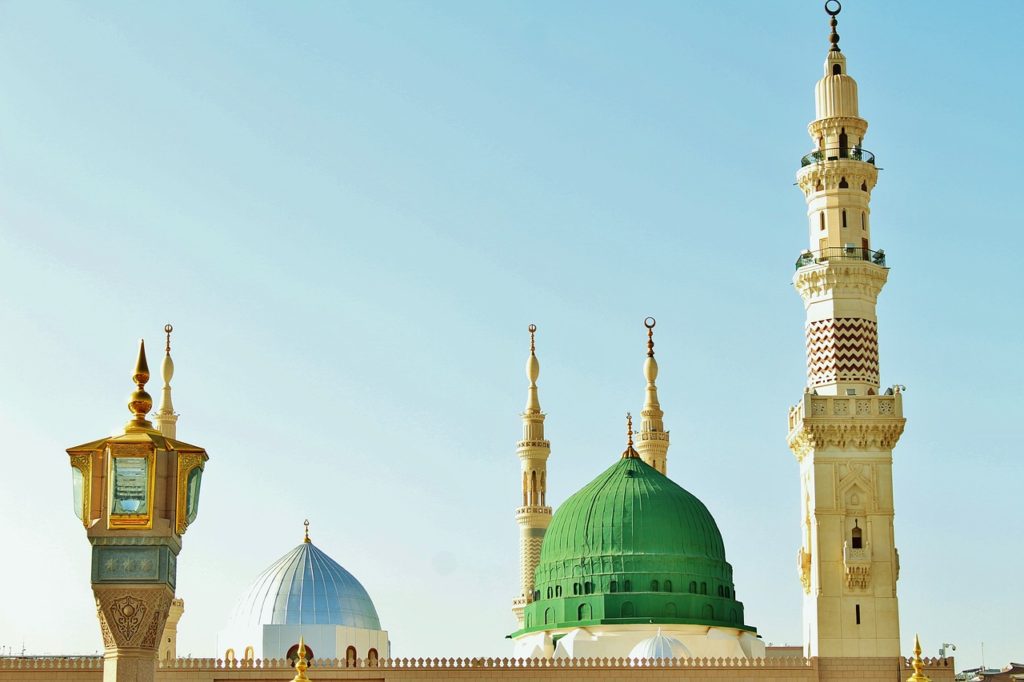
The Holy Prophet’s (pbuh) Mosque
The Prophet’s Mosque in Madinah served not only as a place of worship but as the epicentre of the burgeoning Muslim community. It was a hub for spiritual guidance and functioned as a social and educational centre, fostering a sense of unity and fraternity among diverse groups of Muslims and non-Muslims alike.
The collection of ahadith records the various roles the Prophet’s Mosque played and serves as a blueprint for all future generations to follow:
- A place of worship for every believer
- A place for learning from the Prophet
- A place for achieving spiritual purity
- A place for social interaction
- A place for health and social care
- A place for social gatherings and consultation
- A place for festivity with joyous occasions
One should often reflect on how magnetic the atmosphere must have been in the Prophet’s time; attracting believers and non-believers and guiding them towards a God-centric life.
The role of mosques in a pluralist society
Mosques, particularly purpose-built ones, in pluralist societies such as contemporary Britain aim to fulfil these multifaceted roles by providing places of worship to believers as well as social support, educational programs and various outreach activities. They serve as platforms for interfaith dialogue, promoting understanding and cooperation amongst different religious and non-religious communities so they can live in harmony.
Some large mosques act as cultural hubs, preserving and promoting Islamic heritage through art, architecture, and cultural events. They play a crucial role in charitable endeavours, organising food drives, healthcare initiatives, and support services for the poor and disadvantaged – irrespective of people’s religious affiliation.
The governance of mosques in Britain vary in structure and leadership. Those that operate democratically with elected committees representing diverse local communities and serving all people, mirror the inclusive governance model of the Prophet. Mosques that are professionally managed in a consultative manner are vital for successful communities who want to play their civic and public role effectively in the wider society.
However, like all communities with regard to their religious places, Muslims have shortcomings that are reflected in their governance of mosques. With all the challenges facing Muslims in contemporary society, including Islamophobia, prejudice and other stereotypical accusations, mosques have a significant role to play in combating social ills with creative ideas and broader engagement with the wider society. Mosques must evolve and be vital institutions with effective plans and programs to contribute positively to social cohesion, religious tolerance and public welfare.
Maximising the role of mosques
Mosques have important tasks to not only teaching Muslims the Qur’an, Sunnah and message of Islam – but also to educate the community, especially the younger generations, on how to effectively uphold the spirit of inclusivity and working for the common good. By their nature, mosques are more than just the hardware or the building made of bricks and mortar. The congregation attending or serving the mosques operate as the human software working as a force for good to all in the local communities as well as the wider society, sharing the teachings and values of Islam.
However, the unfortunate reality is that some mosques lack the expertise, professionalism and needed resources to provide the aforementioned services. Whilst small mosques may just be for congregational prayers with the occasional facility to teach children how to recite Qur’an, purpose-built mosques that hold regular Friday congregations should have strong provisions for all, including women and children. Limitations of physical space, financial resources or challenges in getting planning permission should not inhibit the communities’ ambitions to use mosques as the social hub for people around. Whatever the constraint, mosques in any Muslim-minority country where Muslims are seen as ambassadors of their faith and Islam is misunderstood, should be competently run to reflect a positive image of Islam as well as the Muslim community.
They are required to strive for excellence and never be complacent with the status quo. Devoting time and wealth and giving maximum effort to make society better in fairness, peace and harmony brings great reward on the Final Day.
Conclusion
The key to success for Muslims across the world is to emulate the Prophet in their individual, communal and public life. Mosques should be at the heart of the community, providing all its congregants a fellow-feeling, and help to develop their skills, knowledge and experiences.
British mosques must play their part in shaping Muslim individual and community life so that believers can raise their spirituality as well as participate in civic and public affairs effectively. Excelling in whatever a Muslim does is a religious imperative. The pursuit of excellence, or ‘Ihsan’ in the Qur’an, is linked with perfection, righteousness and willpower. Ihsan is a dominant trait of successful believers and mediocracy is not acceptable. The powerful hadith, “Verily, Allah has prescribed excellence in all things …” (Muslim) evidences that Allah loves those who strive towards Ihsan, or the ‘Muhsinun’.
Mosques that seek to operate at the highest standards will create a sense of community belonging, fellow feeling and can solve the internal and external challenges facing Muslims today.