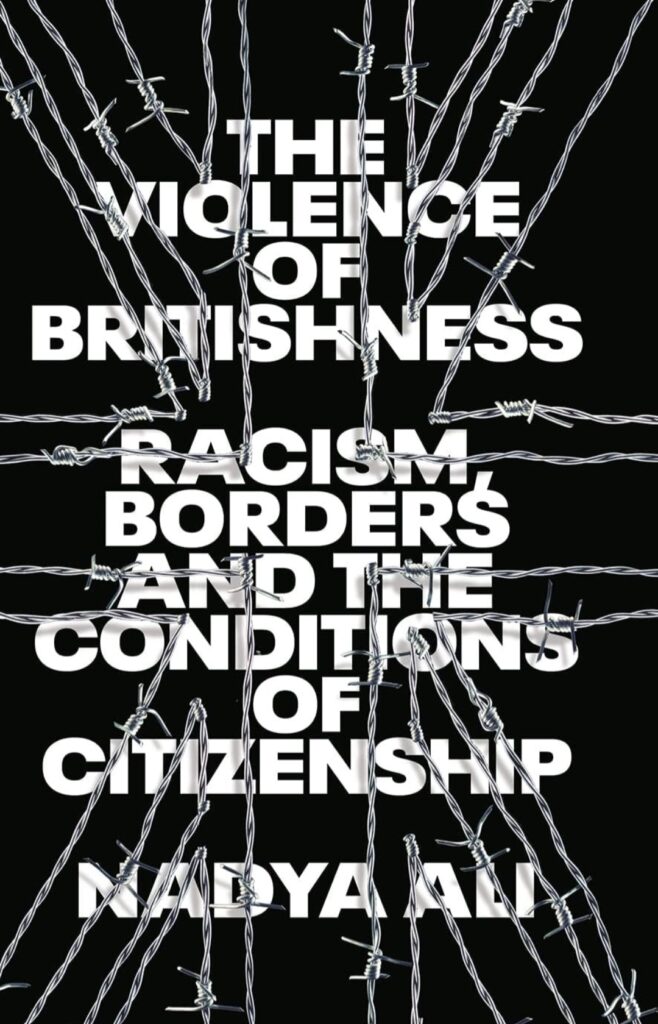
By Nadya Ali, Pluto Press, 2023. Pp159.
The Violence of Britishness is an insightful exploration of racism and citizenship in the context of British identity. Nadya Ali’s work offers a critical analysis of the intersections between race, religion, nationalism and colonial legacy and sheds light on the complexities of British identity and the systemic exclusion and hostility experienced by marginalised communities. Positioning her analysis within a broader contextual view of the hostile environment, austerity, and the cost-of-living crisis, Ali shows how rights as a citizen may be conditional and dependent upon who the state counts as sufficiently ‘British.’
The Violence of Britishness begins from the premise that counter-terrorism and immigration policies are both projects of ‘racial bordering which operate in mutually reinforcing ways to keep Britain white’. In her meticulous analysis, Ali unearths the reality of these policies and examines their impact on Muslims and other racially minoritised groups. Ali dissects the Prevent strategy and shows how Muslims are expected to reform their conduct and even their faith to prove their ‘Britishness’. The penalty for not complying is being pigeon-holed as ‘extremists’, leading to further ostracisation from the state.
Early on, Ali introduces the reader to two examples of Britain’s ‘postcolonial citizens’ who were born in Britain or have lived here most of their lives, yet neither are considered to be adequately British. They are always from somewhere else, usually parts of the former British Empire, ‘to where they can ultimately be sent back’. This reality has most recently been embodied in the anti-refugee Borders and Nationality Act (2022), Ali asserts.
Ali has no qualms that postcolonial citizens are viewed as ‘perpetual immigrants’ and minorities in Britain where the clarion call is to ‘take back control’ and protect what is seen as rightfully ‘belonging to white Britons’. Sections of the British public maintain a belief that Britain was a ‘uniquely liberal empire’ that gave colonised populations the ‘benefits of civilisation’. While colonisation has always been regarded in history as an evil act, many liberal-minded Britons have consistently demonstrated feelings of pride in their colonial history. It is no wonder then why imperial amnesia and nostalgia have been the subjects of fevered discussion precipitated in large part by the 2016 referendum on EU membership.
Written over five chapters, the book starts with the London bombings in July 2005, widely known as 7/7, which was seen by the establishment as the Muslim community’s failure to govern itself. There was little nuance and realism in this assertion. In spite of Muslims hailing from diverse and often difficult backgrounds from the four corners of the world and settling with disadvantaged socio-economic conditions in post-War Britain, they were in effect lumped into one homogeneous group by the government.
The so-called antidote, Prevent, was thus issued as an invitation to Muslims: “accept collective responsibility for acts of individual violence and take measure to enact reform or face the disciplinary consequences.” Muslim religious practices or Muslimness became a matter of concern and promoted panacea was Prevent. This narrative conveniently removed the 7/7 bombers from wider British society and rendered them a product of a self-contained, ghettoised and dysfunctional Pakistani community. Muslims thus are seen as a problem minority by many. ‘Wahabism’, ‘Islamism’, and ‘Salafi-Jihadism’ became the discourse to define terrorism-prone Islam.
The author takes a swipe at the Muslim Council of Britain (MCB), alleging that it was a ‘key partner’ of the New Labour government in its response to 9/11 and the War on Terror, but ‘was not able to secure the support of British Muslims for the war in Iraq’. The truth is that MCB, since its inception in 1997, worked with mainstream society including various arms of the British establishment, only until the drumbeat of the impending Iraq invasion came to fruition. 9/11 was an unparalleled shock to everyone and Muslims everywhere were unsure how to respond in the beginning. But when the then Labour Government under Tony Bliar sought support from Muslims for its illegal Iraq war, the overwhelming Muslim population including the MCB opposed it.
The second chapter, Domesticating Muslims, starts with the infamous Trojan Horse affair as ‘yet another example of how colonial ideas about a Muslim conspiracy were invoked and adapted for the context of postcolonial Britain.’ This initiated a set of political interventions to ‘domesticate’ Britian’s Muslim population. The architect was none other than the then Education Secretary Michael Gove who in his earlier book, Celsius 7/7, had articulated about an Islamic takeover ‘echoing Cold War fears of Trotskyist entryism into the British state apparatus’. All this has led to the establishment assumption that even though Muslims in Britian are citizens with the same notional rights and entitlements as other citizens, they are ‘assumed to be not British enough’.
Chapter 3, Conditional Citizenship, starts with the idea that ‘while Muslims are citizens with the same formal rights as other Britons, their ability to act politically is curtailed’. The author highlights the issue of ‘gendered impacts of conditional citizenship on Muslim women and their ability to participate in public life’, particularly from the example of the sacking of Conservative MP Nusrat Ghani as a minister in 2020 when a government whip told her that her Muslimness was making colleagues uncomfortable.
Chapter 4, The Hostile Environment highlights the Windrush scandal and how immigration legislation aimed at keeping out non-citizens led to ‘thousands of Black and brown Britons losing their jobs, homes, benefits, access to healthcare and in some case being deported’. Ali asserts that the hostile environment, like the Prevent Strategy before it, has effectively instituted a more formalised regime of everyday racial bordering making the ‘citizenship of Britain’s postcolonial people conditional’.
In the final chapter, Hierarchies of Citizenship in White Britain, the idea of Britain as a white nation rather than a white empire took shape through the process of post-war decolonisation in which non-white Britons have experienced life at the ‘bottom of a hierarchy of citizenship’. Most importantly, in a post-Brexit Britain wracked by multiple crises, the entitlements of citizenship grow increasingly precarious. ‘Britishness’ is a way of understanding the nation shaped by white nationalism that acts as a powerful tool of racial bordering, separating the deserving from the undeserving.
In conclusion, The Violence of Britishness is a valuable, enlightening and thought-provoking read that offers valuable insights into race and citizenship in contemporary Britain. Its engaging narrative and wealth of information makes it a must-read for anyone interested in this topic.